marzo 2022

Noticias de Norteamérica
In December 2021, the Maine Department of Environmental Protection published the list of food contact chemicals of high concern.
In June 2019, Maine signed the Toxic Chemicals in Food Packaging legislation into law. The law required the Maine Department of Environmental Protection (DEP) to publish a list of 10 or less food contact chemicals of high concern in order to determine their use in food packaging, if any, and identify if there are safer alternatives.
In December 2021, the DEP published the finalized list of 10 food contact chemicals of high concern. These chemicals are:
- Bisphenols structure (Bisphenol A, Bisphenol B, Bisphenol S, and Bisphenol F)
- 4-Octyl phenol
- Octamethyl cyclotetrasiloxane (D4)
- Toluene
- Styrene
- Benzene
- Methylenedianiline (MDA)
- Paraben structure (Propyl paraben, Butyl paraben, Methyl paraben and Ethyl paraben
- Benzophenone
- Nonylphenol
Para más información sobre esta historia
- Póngase en contacto con : Carol Gao (Technical Consultant - FCMs)
- Teléfono : (852) 3185 8000
- Correo electrónico : regulatoryupdates@qima.com
The state of Rhode Island introduced Senate Bill 2049 on 25 January 2022 for the prohibition of per- and polyfluoroalkyl substances (PFAS) in food packaging, clothing and carpeting. Similarly, the state of New Hampshire also proposed an act (House Bill 1589) in early January 2022 for the prohibition of the sale of all products including, but not limited to, carpets or rugs containing intentionally added PFAS.
The proposed act of Rhode Island, Senate Bill 2049, prohibits any person to manufacture, sell or distribute for use, food packaging containing intentionally added PFAS in any amount. The act also requires that any carpeting or clothing containing PFAS manufactured or sold in the state should carry a warning label. Any person who violates the provision shall be subject to a fine of not more than one thousand dollars for each offense. The act would take effect on 1 January 2023.
Another similar act prohibiting the sale of products containing intentionally added PFAS has been proposed in the state of New Hampshire, House Bill 1589, in which a wider product scope is covered.
- Beginning 1 January 2023, a written notification shall be submitted to the state department by any manufacturer of a product for sale that contains intentionally added PFAS.
- Beginning 1 January 2024, no person shall sell, offer for sale or distribute for sale in the state, a carpet, rug or a fabric treatment that contains intentionally added PFAS.
- Beginning 1 January 2030, the same restrictions shall be extended to any product that contains intentionally added PFAS.
Para más información sobre esta historia
- Póngase en contacto con : Alex Hui (Senior Technical Manager)
- Teléfono : (852) 3185 8000
- Correo electrónico : regulatoryupdates@qima.com
The US Consumer Product Safety Commission (CPSC) issued two Notices of Proposed Rulemaking to address unsafe accessible cords in both stock and custom window coverings. The CPSC is accepting comments on both proposed rules until 23 March 2022.
The CPSC issued two notices of proposed rulemaking (NPR) on 7 January 2022 for window coverings.
The purpose of the proposed rules is to address the risk of strangulation of children eight years old and younger associated with hazardous operating cords on custom window coverings.
One proposed rule would require operating cords on custom window coverings to meet identical requirement for operating cords on stock window coverings, as set forth in section 4.3.1 of ANSI/WCMA A100.1-2018, American National Standard for Safety of Corded Window Covering Products (ANSI/WCMA-2018). The ANSI standard requires stock window coverings to have:
No operating cords (cordless) (section 4.3.1.1);
Inaccessible operating cords (section 4.3.1.3); or
Operating cords shorter than 8 inches in any use position (section 4.3.1.2)
The other proposed rule is to deem window coverings with the following characteristics to contain a "substantial product hazard" (SPH), as defined in section 15(a)(2) of the Consumer Product Safety Act (CPSA):
The presence of hazardous operating cords on stock window coverings;
The presence of hazardous inner cords on stock and custom window coverings; or
The absence of a required manufacturer label
Para más información sobre esta historia
- Póngase en contacto con : Vivian Chan (Technical Consultant – Toys)
- Teléfono : (852) 3185 8052
- Correo electrónico : regulatoryupdates@qima.com
On 9 February 2022, New York State published new Assembly Bill A9223 which prohibits the sale of magnetic jewelry meant to mimic a tongue piercing and requires a warning to be printed on other products containing a small magnet.
The New York State assembly bill (Assembly Bill A9223) states a jewelry product that includes a small magnet and is marketed as a product designed to mimic a tongue, lip, or nose piercing is not allowed to be sold. Other consumer novelty products containing a small magnet must be labelled or tag-affixed with the below warning statement (or equivalent text.) This text must be distinctly visible to the consumer and printed in a clear and conspicuous type.
"WARNING. This product contains (a) small magnets. Swallowed magnets can stick together across intestines causing serious infections and death. Seek immediate medical attention if magnet(s) are swallowed or inhaled."
This requirement shall not apply to products that are required to comply with the magnet safety and labelling requirements of ASTM F963.
This act would take effect 120 days after being signed into law.
Para más información sobre esta historia
- Póngase en contacto con : Vivian Chan (Technical Consultant – Toys)
- Teléfono : (852) 3185 8052
- Correo electrónico : regulatoryupdates@qima.com
In the US, when hazards are identified in consumer products, they will be recalled and published in the Consumer Product Safety Commission (CPSC) Recent Recalls on the CPSC website, which is updated daily. The US recalls from 01 February 2022 to 28 February 2022 are summarized below:

|
Hazards |
Frequency |
|
Burn Hazard |
6 |
|
Choking Hazard |
4 |
|
Injury Hazard |
4 |
|
Entrapment Hazard |
2 |
|
Fall Hazard |
4 |
|
Fire Hazard |
7 |
|
Lead Poisoning Hazard |
2 |
|
Other Hazards* |
4 |
* Other Hazards include Drowning Hazard, Tip-Over Hazard, Laceration Hazard and Electric Shock Hazard with a frequency of less than 2.

|
Product Categories |
Frequency |
|
Fabric / Textile / Garment / Home Textile |
6 |
|
Toys and Childcare Products |
6 |
|
Tools and Hardware |
2 |
|
Furniture |
2 |
|
Sporting Goods / Equipment |
1 |
|
Home Electrical Appliances |
4 |
|
Electrical Appliances |
2 |
|
Household Items |
3 |
|
Food Contact Material |
1 |
For a complete list click here
In Canada, when hazards are identified in consumer products, they will be recalled and published in the Recalls and Safety Alerts Database on the Health Canada website, which is updated daily. The Canada recalls from 01 February 2022 to 28 February 2022 are summarized below:

|
Hazards |
Frequency |
|
Health Risk Hazard |
4 |
|
Risk of Allergy |
6 |
|
Burn Hazard |
3 |
|
Chemical Hazard |
2 |
|
Fire Hazard |
2 |
|
Microbiological Hazard |
4 |
|
Choking Hazard |
3 |
|
Other Hazards* |
5 |
*Other Hazards include Aspiration Hazard, Injury Hazard, Strangulation Hazard, Fall Hazard and Laceration Hazard with a frequency of less than 2.

|
Product Categories |
Frequency |
|
Pharmacy |
2 |
|
Food |
9 |
|
Household Items |
4 |
|
Fabric / Textile / Garment / Home Textile |
4 |
|
Bodycare / Cosmetics |
3 |
|
Other Categories* |
6 |
*Other Categories include Home Electrical Appliances, Tools and Hardware, Medical Devices, Food Contact Material, Toys and Childcare Products and Protective Equipment with a frequency of less than 2.
For a complete list click here
Noticias de Sudamérica
On 21 January 2022, the Brazilian Institute of Metrology, Standardization and Industrial Quality (INMETRO) approved the requirements for the conformity assessment and the specifications for the seal of conformity identification for the sound power of domestic appliances, as set out in Annexes I and II respectively of this Regulation. The assessment of conformity through the certification process must be carried out by a product certification body, known as an OCP, established in Brazil, and accredited by INMETRO, in accordance with the requirements approved in this Regulation.
Portaria No. 6, approved by the Brazilian Institute of Metrology, Standardization and Industrial Quality (INMETRO), outlines the requirements for the conformity assessment and the specifications for the seal of conformity identification for the sound power of the following domestic household and commercial appliances:
vacuum cleaner;
blender;
hair dryer; and
other devices that function in the same way.
These Regulations entered into force on 1 February 2022.
The validity period of the CoC (Certificate of Conformity) is 12 months from the date of its being granted. The certification process must be carried out by an OCP, an approved certification body established in Brazil and accredited by Inmetro.
The criteria for authorizing the use of the Conformity Identification shall follow the requirements established in Portaria No. 200/2021 and Annex II.
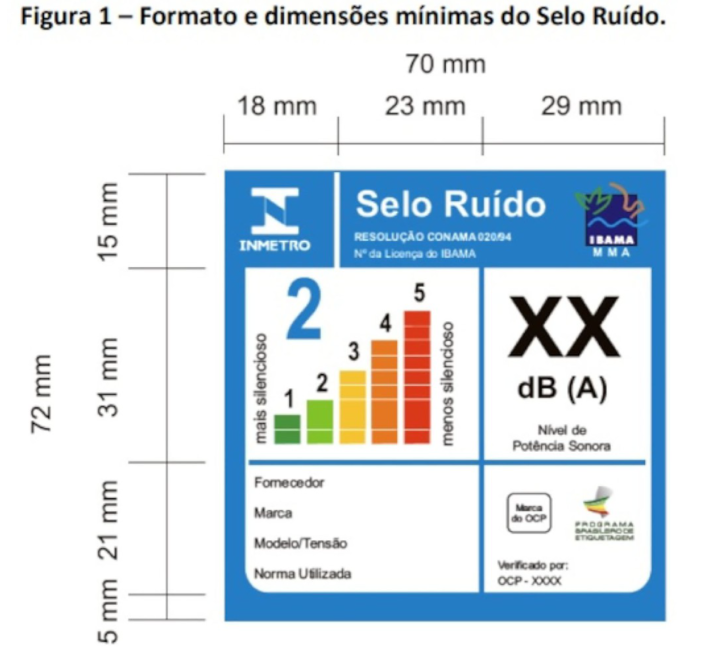
CONFORMITY IDENTIFICATION SEAL
The conformity identification seal, in the form of a noise stamp, must be attached to the equipment by means of adhesive or to its packaging by means of adhesive or printing and is specified below.
The minimum size, color and type of source characteristics of the conformity identification stamp, the noise stamp, are listed in Figure 1.
Para más información sobre esta historia
- Póngase en contacto con : Vincent Wong (Technical Consultant for E&E)
- Teléfono : (852) 3185 8000
- Correo electrónico : regulatoryupdates@qima.com
Noticias de Europa
The European Chemicals Agency has proposed a ban for the placing on the market, use and export of all per- and polyfluoroalkyl substances (PFASs) in firefighting foams. There is a six-month consultation period set to begin on 23 March 2022.
On 23 February 2022, the European Chemicals Agency (ECHA) published the news on REACH Annex XV restriction dossier about the use of PFASs in firefighting foams that are not adequately controlled, based on the risks posed to human health and the environment. A restriction is the most appropriate means to address these chemicals and the "whole PFAS class restriction" will prevent "regrettable substitution" in the future.
ECHA has reviewed the strengths and weakness of five different options, including the overall ban, to manage the associated risks of PFASs in firefighting foam. The blanket restriction (ban), with use or sector-specific transition periods included, has been picked as the "final" option as it is the most effective in targeting the identified risks and is the most pragmatic option as it relates to enforcement and monitoring.
In this proposed restriction, the concentration of total PFASs in firefighting foams cannot exceed 1 ppm. There is a transition period included for the industry so that enough time is allowed for replacing PFAS-containing foams without compromising fire safety. A six-month period beginning on 23 March 2022 is planned and will be open for the public to give evidence-based comments on the proposal. By early 2023, the European Commission will prepare a draft regulation considering ECHA's proposal and the combined opinions of the scientific committees.
It should be noted that several European countries are also beginning the development of a restriction proposal intended to cover PFASs in uses other than firefighting foams. This proposal is targeted for submittal to ECHA in January 2023.
Para más información sobre esta historia
- Póngase en contacto con : Alex Hui (Senior Technical Manager)
- Teléfono : (852) 3185 8000
- Correo electrónico : regulatoryupdates@qima.com
A proposal on regulating two categories of mineral oil in ink on packaging and printed paper matter has been submitted in France. The restriction would be implemented by two phases starting 1 January 2023.
On 3 February 2022, the World Trade Organization (WTO) announced a draft Decree from France's Ministry for Ecological Transition (Ministère de la Transition écologique), under WTO document no. 22-0881, on the intention to regulate two categories of mineral oils and addressed requirements related to Article 112 of Decree No. 2020-105 “Fight Against Waste and the Circular Economy”. The detailed content of Article 112 is shown in table 1.
Table 1. Scope of the ban on use of mineral oil and corresponding effective date under Article 112 of Decree No. 2020-105
|
Product Scope |
Effective date |
|
Packaging |
January 1, 2022 |
|
Printed matter of paper for public * |
January 1, 2025 |
|
* For advertising prospectus letters and unsolicited catalogs aimed at commercial promotion Note: conditions of application are defined by the Decree |
The draft Decree contains several important provisions as listed below:
- Changes the date of entry into force of Article 112 of Decree No. 2020-105 to 1 January 2023 onwards
- Defines mineral oils as "oils produced from feedstocks derived from petroleum hydrocarbons used in the manufacturing of inks"
- Provides definition of mineral oils covered by the ban as: mineral oil aromatic hydrocarbons (MOAH) consisting of 1-7 aromatic cycles and mineral oil saturated hydrocarbons (MOSH) consisting of 16-35 carbon atoms
- Specifies requirements for MOAH and MOSH in ink:
≤ 0.1% MOAH (≤ 1 ppb MOAH compounds consisting of 3 to 7 aromatic cycles from 1 January 2025)
≤ 1% MOSH (≤ 0.1% MOSH from 1 January 2025)
There are two transitional periods:
- Packaging and printed matter of paper manufactured or imported before 1 January 2023, are required to be disposed of by 31 December 2023
- Compliant packaging and printed paper manufactured or imported before each of the deadlines in the aforementioned point 4 are required to be disposed of within 12 months from those deadlines
According to the WTO document, the proposed date of adoption and the proposed date of draft Decree entry into force will be on 30 June 2022 and 1 January 2023, respectively.
Para más información sobre esta historia
- Póngase en contacto con : Alex Hui (Senior Technical Manager)
- Teléfono : (852) 3185 8000
- Correo electrónico : regulatoryupdates@qima.com
On 11 September 2020, issue no. 116 of the Official Journal of the Italian Republic published Legislative Decree no. 3 of September 2020, which implements EU Directive 2018/851 on waste and EU Directive 2018/852 on packaging and packaging waste. According to the new Italian Legislative Decree, all products must have applicable "environmental labelling" on its packaging. The effective date is 30 June 2022.
As stated in Italy's Legislative Decree no. 3 of issue no. 116/2020, "all packaging shall be appropriately labelled in accordance with the procedures established in the applicable UNI technical standards and in compliance with the decisions adopted by the European Commission, in order to facilitate the collection, reuse, recovery and recycling of the packaging, and to provide consumers with proper information on the final destination of packaging." UNI stands for Italian National Standards Institute.
The following includes wording suggested by CONAI, the National Packaging Consortium, although the legislation does not dictate precise required verbiage.
Environmental Labelling of SINGLE-COMPONENT packaging destined for the end consumer; the following information should be given:
The packaging material's identification code under Decision 129/97/EC.
Collection guidelines. It is advisable:
To specify the wording "Collection (main material family by weight)" or
To indicate the main material family by weight, accompanied by the wording "Separate collection", and invite the consumer to check the provisions of his or her Municipality.
Other information that may be voluntarily added to environmental labels as it relates to the type of packaging and as it offers instructions that will guide the consumer towards efficiently being able to separate waste collection.
Environmental Labelling of MULTI-COMPONENT packaging destined for the end consumer; the following information should be given:
Type of packaging (full written description or graphic representation) of the various components that can be separated by hand.
Identification code of the packaging material of each component that can be separated by hand under Decision 129/97/EC.
Collection guidelines, clearly specifying the material family of each component.
Voluntary information to help the consumer separate waste efficiently.
Environmental labelling of packaging destined for professionals, or transport packaging, or packaging related to logistics or exhibition activities must bear:
Code of the composition materials in accordance with Decision 129/97/EC (all other information remains as voluntary.)
The effective date of the previously mentioned environmental labelling is 30 June 2022.
Para más información sobre esta historia
- Póngase en contacto con : Vivian Chan (Technical Consultant – Toys)
- Teléfono : (852) 3185 8052
- Correo electrónico : regulatoryupdates@qima.com
In Europe, when hazards are identified in Non-food Consumer Products, the Products will be recalled and published in the Safety Gate system, which is updated weekly. The European recalls from 01 February 2022 to 28 February 2022 are summarized below:

|
Hazards |
Frequency |
|
Chemical Hazard |
48 |
|
Injury Hazard |
19 |
|
Strangulation Hazard |
6 |
|
Choking Hazard |
26 |
|
Environmental Hazard |
8 |
|
Electric Shock Hazard |
11 |
|
Health Risk Hazard |
7 |
|
Fire Hazard |
12 |
|
Burn Hazard |
11 |
|
Other Hazards* |
19 |
*Other Hazards include Drowning Hazard, Entrapment Hazard, Damage to Sight, Suffocation Hazard, Microbiological Hazard, Damage to Hearing and Cut Hazard with a frequency of less than 6.

|
Product Categories |
Frequency |
|
Toys and Childcare Products |
44 |
|
Outdoor Living Items |
6 |
|
Fabric / Textile / Garment / Home Textile |
12 |
|
Sporting Goods / Equipment |
7 |
|
Electrical Appliances |
10 |
|
Bodycare / Cosmetics |
18 |
|
Machinery |
5 |
|
Protective Equipment |
10 |
|
Chemicals |
7 |
|
Other Categories* |
14 |
*Other Categories include Household Items, Food Contact Material, Computer / Audio / Video / Other Electronics & Accessories, Footwear, Home Electrical Appliances, Jewelry and Furniture with a frequency of less than 4.

|
Notifying Country |
Frequency |
|
Hungary |
20 |
|
Lithuania |
4 |
|
Belgium |
4 |
|
Sweden |
22 |
|
France |
13 |
|
Germany |
10 |
|
Slovakia |
9 |
|
Latvia |
5 |
|
Luxembourg |
5 |
|
Poland |
7 |
|
The Netherlands |
4 |
|
Finland |
4 |
|
Ireland |
5 |
|
Romania |
5 |
|
Other Countries* |
16 |
*Other Countries include Spain, Italy, Austria, Bulgaria, Malta, Norway, Iceland, Croatia, Denmark and Czechia with a frequency of less than 4.
For a complete list click here
Noticias de Asia
On 20 August 2021, the China State Administration for Market Regulation (Standardization Administration) published the Stainless Steel Vacuum Container Standard GB/T 40355-2021. The implementation of this standard began on 01 March 2022.
On 20 August 2021, the China State Administration for Market Regulation (Standardization Administration) published the Stainless Steel Vacuum Container Standard GB/T 40355-2021.Highlights of standard GB/T 40355-2021:
- Standard is a voluntary standard.
- Standard applies to food contact stainless steel vacuum containers for daily use.
- Standard categorizes the stainless steel vacuum container products based on function, usage and types of sealing and outlines requirements for stainless steel vacuum container by categories.
- The requirements include stainless steel material type, stability, deviation of capacity, efficiency of insulation, impact resistance, appearance, etc.
- Identifies that all food contact components of stainless steel vacuum containers shall comply with related mandatory food contact materials regulations.
- Includes marking, labeling and product instruction.
This standard came into effect on 01 March 2022.
Para más información sobre esta historia
- Póngase en contacto con : Carol Gao (Technical Consultant - FCMs)
- Teléfono : (852) 3185 8000
- Correo electrónico : regulatoryupdates@qima.com
Standard FZ/T 81014-2008 for infant's wear was officially abolished. The effective date was 26 January 2022.
Per No. 44 notice in 2021 of MIIT (Ministry of Industry and Information Technology of the People's Republic of China), there were a total of 87 standards abolished, 360 standards updated, and 1287 standards continuing to be in effect. The notice covered nine industries including textiles, in the batch review of industry standards.
Among these previously mentioned changes, was standard FZ/T 81014-2008 for infant's wear which has been abolished since the notice publication day of 26 January 2022. The scope of this standard included, but was not limited to, the terms and definitions of woven infant clothing, requirements, test methods, inspection classification rules, and signs, packaging, transport, and storage.
Currently, national standard GB/T 33271-2016 for infant's woven garments is in effect and is to be followed in place of FZ/T 81014-2008.
Para más información sobre esta historia
- Póngase en contacto con : David Zhao (Technical Consultant)
- Teléfono : (571) 8999 7142
- Correo electrónico : regulatoryupdates@qima.com
In China, when hazards are identified in consumer products, they will be recalled and published in the SAMR Defective Product Administrative Centre, which is updated daily. The China recalls from 01 February 2022 to 28 February 2022 are summarized below:

|
Hazards |
Frequency |
|
Burn Hazard |
1 |
|
Health Risk Hazard |
2 |
|
Safety Risk Hazard |
1 |
|
Chemical Hazard |
2 |

|
Product Categories |
Frequency |
|
Food Contact Material |
3 |
|
Furniture |
2 |
|
Computer / Audio / Video / Other Electronics & Accessories |
1 |

|
Provinces |
Frequency |
|
Guangxi |
2 |
|
Liaoning |
2 |
|
Beijing |
1 |
|
Jiangsu |
1 |
For a complete list click here
Noticias de Australia/Nueva Zelanda
El 9 de febrero de 2022, Nueva Zelanda publicó un aviso de Notificación de Prohibición Indefinida de Bienes Inseguros (Productos Inclinados para el Sueño Infantil) 2022 para mitigar el riesgo de muertes infantiles atribuidas al uso de productos inclinados para el sueño infantil.
La Notificación de Prohibición Indefinida de Mercancías Inseguras (Productos Inclinados para el Sueño de los Lactantes) de Nueva Zelanda de 2022 reconoce y responde a los riesgos que suponen para los lactantes en Nueva Zelanda prohibiendo el suministro de productos inclinados para el sueño de los lactantes nuevos o de segunda mano. También reconoce que los productos inclinados para el sueño infantil no se ajustan a las directrices reconocidas internacionalmente para un entorno seguro para el sueño infantil, que recomiendan una superficie firme y plana para dormir.
En este aviso, según la interpretación, a menos que el contexto requiera lo contrario: Lactante significa un niño menor de un año de edad; Producto inclinado para el sueño del lactante significa cualquier producto:
Que está destinado a contener a un bebé; y
Que esté diseñado, destinado, comercializado o contenga cualquier declaración de que es adecuado para que duerma en él un bebé; y
Que sea independiente o esté diseñado para fijarse a otra estructura; y
Que tiene una superficie de descanso inclinada más de siete grados con respecto a la horizontal cuando
El producto no está cargado; y
En cualquier ángulo diseñado, destinado o comercializado para dormir; y
El producto está en reposo, en el caso de productos que se balancean o oscilan; y
Excluidos los productos sanitarios; y
Excluidas las hamacas, que son productos construidos con un material flexible y suspendidos desde arriba o desde cualquiera de sus lados.
Como se indica en la sección de aplicación, este aviso no se aplica a:
Sistemas de retención infantil, como sillas de coche o cápsulas, que son productos diseñados para el transporte de niños y que cumplen la Norma de Transporte Terrestre (Usuario de la Carretera) de 2004;
Productos con ruedas diseñados para transportar niños, como cochecitos o sillas de paseo;
Productos diseñados para llevar a un bebé sobre el cuerpo de otra persona, como fulares y portabebés;
Productos con una inclinación ajustable, en los que cada ángulo diseñado, destinado o comercializado para dormir es igual o inferior a siete grados con respecto a la horizontal;
Productos que lo son:
Diseñados, destinados y comercializados únicamente para el juego y/o la diversión de bebés y niños pequeños, como hamacas y asientos de juego; y
No están diseñados, destinados, comercializados o contienen ninguna representación de que son adecuados para dormir.
La fecha efectiva de este anuncio fue el 9 de febrero de 2022.
Para más información sobre esta historia
- Póngase en contacto con : Vivian Chan (Technical Consultant – Toys)
- Teléfono : (852) 3185 8052
- Correo electrónico : regulatoryupdates@qima.com
En Australia, cuando se identifican peligros en los productos de consumo, se retiran y se publican en la base de datos de retiradas y alertas de seguridad del sitio web de la Comisión Australiana de Competencia y Consumo, que se actualiza diariamente. A continuación se resumen las retiradas de Australia desde el 1 de febrero de 2022 hasta el 28 de febrero de 2022:

|
Peligros |
Frecuencia |
|
Peligro de quemaduras |
3 |
|
Peligro de asfixia |
6 |
|
Riesgo de alergia |
5 |
|
Peligro para la salud |
4 |
|
Peligro de incendio |
2 |
|
Peligro de lesiones |
12 |
|
Peligro de asfixia |
2 |
|
Peligro de ahogamiento |
2 |
|
Otros peligros |
3 |
*Otros Peligros incluyen Peligro de Caída, Peligro Microbiológico y Peligro de Atrapamiento con una frecuencia inferior a 2.

|
Categorías de productos |
Frecuencia |
|
Juguetes y artículos de puericultura |
5 |
|
Alimentación |
5 |
|
Productos sanitarios |
5 |
|
Electrodomésticos |
2 |
|
Herramientas y hardware |
2 |
|
Artículos deportivos / Equipamiento |
3 |
|
Otras categorías |
6 |
*Otras categorías incluyen Material en contacto con alimentos, Componentes de automóviles, Artículos de exterior, Farmacia, Ordenadores / Audio / Vídeo / Otros productos electrónicos y accesorios y Muebles con una frecuencia inferior a 2.
Para consultar la lista completa, pulse aquí
Suscríbete a nuestras actualizaciones regulatorias
Date de baja en cualquier momento. Lea nuestra política de privacidad.